October Focus: Prison’s Week 11 – 17 October
We are introducing a new feature to the newsletter where we will take a theme or national initiative and invite you to reflect and pray. This month’s focus is ‘Prisons Week’.
Prisons Week has featured in our worship for some time and for the past few years, we have had the privilege of hearing from Revd Dr Phil Wall, our former minister, about the experiences of the young people at Oakhill Secure Training Centre for young offenders. Phil has moved to a new job and won’t be leading our worship this year, but Prisons Week remains an important annual focus in the Christian calendar.
This year’s campaign is inspired by Matthew 22: 1 – 14, which says: ‘the servants went out into the streets and gathered all the people they could find, the bad as well as the good, and the wedding hall was filled with guests’
We are invited to join in prayer during Prisons Week, praying for all those who are part of the criminal justice system using the Prisons Week Prayer:
Lord, you offer freedom to all people. We pray for those in prison. Break the bonds of fear and isolation that exist. Support with your love prisoners and their families and friends, prison staff and all who care. Heal those who have been wounded by the actions of others, especially the victims of crime. Help us to forgive one another, to act justly, love mercy and walk humbly together with Christ in his strength and his Spirit, now and every day. Amen.
We are also invited to watch this year’s campaign video:
https://www.prisonsweek.org/watch-film/
And use the Prisons Week prayer diary to guide our prayers through the week:
https://www.prisonsweek.org/wp-content/uploads/2026/09/PrisonsWeek-
Source: https://www.prisonsweek.org/ [accessed 20/09/2026]
News from around the Pastorate
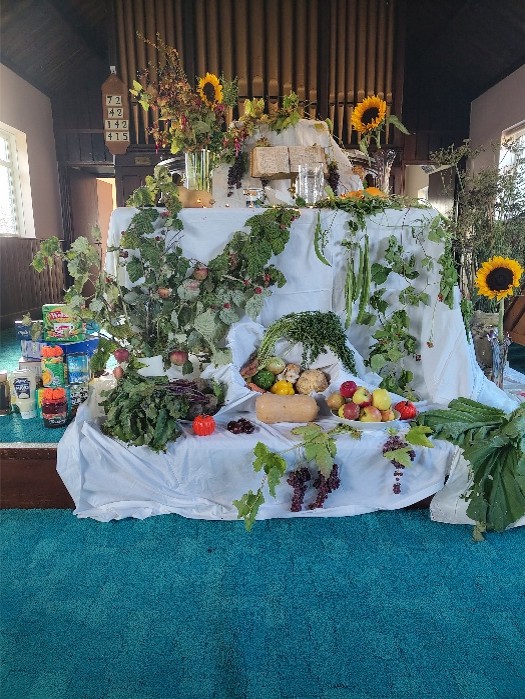
Bethany URC was spectacularly decorated for a joint harvest service with Van Road URC in September and a large number of donations was gathered for Ystrad Mynach’s Tin on a Wall. The display also included some salt, some coal and some water – but Clare forgot to ask the meaning of them, can anyone let her know the significance of the tradition?
Van Road URC held the fourth in a series of fundraising coffee mornings for RNLI in September – the final one will be Christmas themed on Saturday 5 December at 10.30am. All are welcome – the church is hoping its fundraising total will reach £1,000 by the end of the year. Van Road will also be holding a Ploughman’s Harvest Tea on Saturday 10 October at 4pm, everyone is welcome to join them.
New things are happening at Hope and Market Square United Church (URC/PCW) – they are delighted to be ordaining a new elder in November, they are working towards launching a new website and in October they will trial a new midweek service – a Christian Mindfulness service led by Clare (20 October at 10.30am). Please hold church members and the local community in your prayers as the 60th anniversary of the Aberfan disaster approaches and the church reflects on how to mark the day.
Presbyterianism in Welsh History
This is a letter in Reformed-Issue 5, (the URC magazine) written by Rev Noel Davies of Swansea, who has been a guest preacher at St David’s Uniting Church in the past. It was written in response to an article in issue 3.
“I was intrigued by the Revd Dr Michael Hopkins’ article (‘1876: when English Presbyterianism refused to Die’ Reformed-issue 3). As a retired Minister of Undeb yr Annibynwyr Cymraeg (the Congregationally-ordered Union of Welsh Independants. UWI), worshipping now in a URC/Methodist Uniting Church in Swansea, there was much that I found intriguing.
There were interesting echoes of aspects of the Nonconformist story of Wales, as well as some contrasts. The UWI held its first Assemble in 1872. Before that date local Welsh congregational churches gathered together in county unions rather than in a national federation. There were motivations of national identity and mission behind the decisions in 1872 and 1876.
But predating that first UWI Assembly by 61 years was the first gathering for ordinations, in 1811, of what became the Presbyterian Church of Wales (PCW) Assembly, that had hitherto met in associations. These Presbyterian churches in Wales were the product of the Welsh Evangelical Revival led by Daniel Rowland and Howell Harries in the latter years of the 18th century, that ran in parallel with, but was distinct from, the Evangelical Revival that led to Methodism. The one was Calvinistic (hence, in Welsh, Y Methodistiaid Calfinaidd), the other Arminian. It’s worth noting that there were three Presbyterian Church of England local churches in Wales, existing independently of the PCW and becoming part of the URC in 1972 – and in Swansea one of these churches was located more or less opposite and English-Language PCW church.
My father and one of his brothers were trained for UWI ministry in an institution founded in Carmarthen in 1840 called the Presbyterian College, where the term ‘Presbyterian’ did not refer to Presbyterian polity in the sense used above, but to Unitarianism, and offered training also for Congregational ministry. The ‘Presby’, as everyone knew it, dated back to the first dissenting academy in Wales, established in 1689.
This intertwining of historical roots and developments is intriguing certainly. But what do all these interconnections, past and present, say about our shared identities and our search for deeper unity today? Answers for another day!
Page 4/8